
Just Breathe!
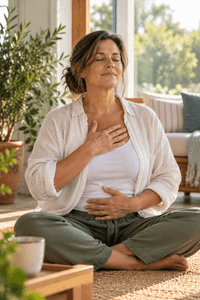
What if one of the simplest tools for supporting your health was something you already have with you every moment of the day?
You rarely think about your breath. It happens automatically, thousands of times a day, whether you are paying attention to it or not. Yet the way we breathe can be one of the best tools to help us when we are stressed, anxious, or even when we are experiencing pain.
Breathing techniques can be a valuable part of a healthy lifestyle and a personal wellness practice. Three simple techniques you can use are belly breathing, box breathing, and yogic breathing.
Belly Breathing: Finding Your Center
Belly breathing, also called diaphragmatic breathing, encourages you to use your diaphragm more fully instead of relying mainly on the muscles of your upper chest.
Try it by sitting comfortably or lying down. Place one hand on your chest and the other on your abdomen.
Slowly breathe in through your nose and allow your abdomen to gently expand. Try to keep the movement in your chest relatively small. Then exhale slowly and comfortably, allowing your abdomen to soften.
These are not enormous breaths, but slow, gentle, and comfortable ones.
Belly breathing can be especially useful when you notice yourself becoming tense or overwhelmed. Taking a few minutes to focus on a slower, more comfortable breathing pattern can signal you to pause, settle, and reconnect with your body.
Try it: Spend 3–5 minutes practicing belly breathing when you first wake up, before bed, or anytime you need a moment to reset; it can definitely help when you are experiencing pain.
Box Breathing: A Four-Part Pause
Box breathing is a simple technique often taught to bring structure and awareness to the breath.
It is a simple 4-part breathing pattern, with each segment to the count of 4.
Inhale — 4 counts
Hold — 4 counts
Exhale — 4 counts
Hold — 4 counts
The counting gives your mind something simple to focus on, which can help interrupt the cycle of racing thoughts and bring your attention back to the present moment. The goal isn’t to hold your breath for a specific amount of time—it is to find a rhythm and flow that feels calm and sustainable for you.
Try it: Before an important meeting, during a stressful day, or when you notice your thoughts becoming scattered, take a few slow rounds of box breathing.
Yoga Breathing: Pranayama
Yoga has included intentional breathing practices, known as pranayama, for centuries. In yoga traditions, the breath is considered an important connection between the body and mind.
Pranayama includes many practices, ranging from very simple to quite advanced. For a beginning wellness practice, you don’t need anything complicated.
One gentle option is alternate-nostril breathing, traditionally called Nadi Shodhana.
Sit comfortably with your spine relaxed and upright. Close your eyes if that feels comfortable.
- Close your right nostril and gently inhale through the left.
- Close the left nostril and exhale through the right.
- Inhale through the right.
- Close the right nostril and exhale through the left.
- Continue for several comfortable rounds.
Keep your breathing relaxed rather than trying to take very deep breaths.
For some people, this becomes a wonderful transition between a busy day and a quieter evening. You can also incorporate it into meditation, yoga, or a morning wellness routine.
Why Does Breathing Matter?
Breathing is closely connected with the autonomic nervous system, which helps regulate many automatic functions of the body.
When we experience stress, the body can shift toward a more alert, activated state. Slowing down and intentionally focusing on the breath may help promote a greater sense of calm and relaxation.
That’s why I think of breathing exercises as a health ritual rather than just another item on a wellness checklist.
You don’t need special equipment.
You don’t need a gym membership.
You don’t need an hour.
You simply need a few quiet minutes and your breath.
Make It a Daily Ritual
Consider pairing your breathing practice with something you already do every day.
Morning: Begin the day with 3–5 minutes of belly breathing.
Midday: Use a few rounds of box breathing as a reset between activities.
Evening: Practice gentle yoga breathing before meditation, stretching, or bedtime.
I like to create a calming environment dimming the lights, diffusing a favorite essential and placing your hands over your abdomen as you breathe. The goal is to become more aware of your breath and give yourself permission to slow down!
We often look for complicated answers to improving our health. Sometimes the simplest practices are the ones we overlook.
Your breath is always with you. Learning to pay attention to it can create a small space between stimulation and response, stress and relaxation, doing and simply being.
So the next time you feel overwhelmed, pause, put down the phone, drop your shoulders, take a comfortable breath in, and slowly breathe out.
Sometimes healing begins with simply giving yourself permission to breathe.
Note: Breathing exercises are complementary practices and should not replace medical care. If a breathing exercise makes you dizzy, uncomfortable, or short of breath, stop and return to your normal breathing. People with respiratory or cardiovascular conditions should discuss new breathing practices with their healthcare professional.
Ready to Take the Next Step?
If you’re ready to take a more intentional approach to your health and wellness, I’d love to support you. Schedule a time to connect and let’s talk about where you are, where you’d like to be, and how I can support you along the way.